


 “Home is where the hurt is.”
Author: Chuck Wendig
Four outcasts. One-star student. Five friends. Matty is the star student, the good one, the one who watches after the others. The one who fights bullies, who throws his lot in with his traumatized friends, who sinks his reputation by hanging out with the “bad” kids. The druggies. The kids with no future. Matty is the glue, the hope. Until one night, camping in the woods, when they find a lone staircase. Matty goes up it . . . and is never seen again. Twenty-years later, everyone in the town still thinks he was murdered by those “bad kids” he protected. And the bad kids – they’ve never told anyone what happened that night. They certainly never mentioned the staircase.
Now, one of the friends is dying, and he’s called the group back together. It’s time to go back into those woods, to face that staircase, to find out what happened to Matty, to see if he can be saved.
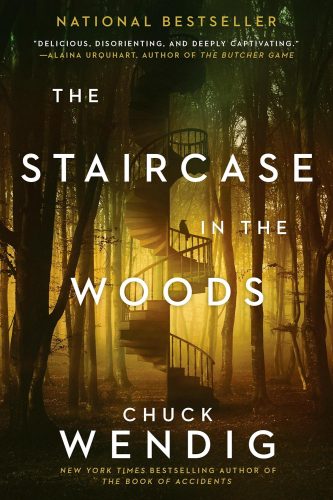
It’s a cool idea with Stephen King It vibes, harkening back to the “Losers Club” and explorations of childhood trauma. But it’s not Stephen King, and even a cool idea and what is admittedly an awesome cover photo can’t save this story from its preachy, dull triteness.
Like everyone, author Chuck Wendig has opinions. Opinions about politics, sexuality, women’s rights, the whole nine yards. Unlike everyone else, you don’t get to spend more than five seconds before you get lambasted with those opinions, touted as righteous facts. There are literally interruptions to the action (repeated interruptions!) as one of the characters gets on his or her soap box with an angry diatribe that has absolutely nothing to do with the narrative itself.
Now, I’m not against authors using art to express their values and morality. That is one of the shining features of art, and I consider writing one of the highest art forms of all. Writing – storytelling – is how we collectively make sense of our world. How we learn. How we grow. How we foster empathy and educate others on the varied experiences of humanity. It’s what takes writing beyond entertainment and makes It sublime. But . . . this very act of weaving a story with meaning is something that requires care and finesse. It must be organic. Stephen King, I would argue, is the perfect example of this. And let me get one thing straight here, I rarely agree with King’s outlook or politics . . . but they fit his stories and characters; they add rather than detract. King creates art and makes a point. Wendig, in my opinion, makes more of a Reddit style rant than work with a soul, and it hurts the narrative.

Image by Seidenperle from Pixabay
Case in point, when we meet the only female character in this story, Lore, the narrative grinds to a total halt to let her tell us (and her now-conservative Trump-supporting ex-friend) that she is a pansexual, autistic, ADHD, aromantic, she/they in an on-again-off-again polycule. Who introduces themselves with this much detail? How does this come up in conversation? What does this have to do with the damn staircase? Can’t we learn these things about the character organically? Show, don’t tell was the mantra of my grad school writing classes (I have an MA in writing, believe it or not.) Lore didn’t FEEL real, and if your characters don’t feel real, you don’t care about the danger they encounter. She wasn’t the only character portrayed in this manner either.
All the characters are selfish and self-centered as well. None of them were particularly likable, and Lore was the only one who got that got much fleshing out, and that was in the form of a political rant, not a real person just living her life. The only one I kind of liked was Owen, but that was more because of the (very weak) OCD representation.
All of these “friends” are more enemies too. Their connection to one another doesn’t really make sense. The vibes they give each other, even when they were young, equated more to hatred than friendship. This made me feel even more distanced from the narrative. I didn’t like anybody. They were all backstabbing each other (except Matty), and despite their varied formative traumas, which are slowly revealed, none of it makes them either empathetic or interesting.
The extremely slow pacing and the repetitive nature of the narrative, once it finally stops with the preaching and gets the characters up the stairs, further distanced me from the story. There were good bones, some half decent ideas and thoughts on trauma, but the narrative was too unfinished, too slapdash, and there were too many plot holes that, with any expert poking, could easily unravel, such as the escape “work around” for the magic of the stairs.
With more finesse, with more subtly and realism, with more brevity and less repetition, with characters who had some iota of goodness or at least charisma, The Staircase in the Woods could have been good. As it was, I am done with Chuck Wendig. This is my second book of his, the first being Black River Orchard, and I am just not feeling his approach to narrative. The same issues that distanced me here distanced me in Black River Orchard. Plenty of horror-hounds out there love this book though, so read through the reviews. Just know that this is a big book, and if you think it may not be to your taste, don’t waste the reading time.
– Frances Carden
Follow my reviews on Twitter at: https://twitter.com/xombie_mistress
Follow my reviews on Facebook at: https://www.facebook.com/FrancesReviews

- Book Vs Movie: The Shining - April 6, 2020
- Thankful For Great Cozy Mysteries - December 13, 2019
- Cozy Mysteries for a Perfect Fall - October 20, 2019