


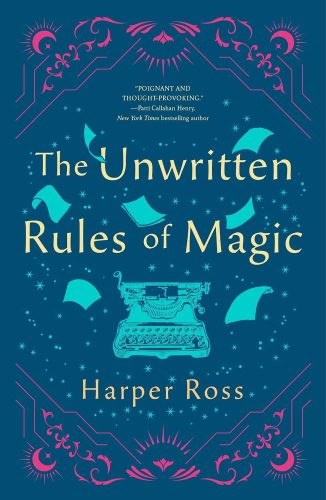
Be Careful What You Wish For
Author: Harper Ross
All Emerson has ever wanted is stability in her life. A father who supports her writing. A mother who turns to family and not drink. A romance that works out. A daughter who shares her hopes and fears. But of course, stability is just a covering for control. Emerson is desperately afraid of the pain and uncertainty of life. She wants everything to work out – and don’t we all. So, what would you do, then, if you had the ability to wish away all the bad things, to wrestle control back from life, to make sure everything, ultimately, turns out ok? To stop pain, to stop trauma? Wouldn’t you take that magical chance?
For Emerson, this is no hypothetical exercise. Her distant, bestselling, critical father is dead. Her alcoholic mother is more than ready to move on. Her daughter is withdrawing from everyone, and now Emerson has accidentally stumbled upon the key to her father’s unremitting success: a typewriter that makes wishes come true. And she uses it. Again and again. To stop her mother from selling the family house. To find a man. To lose weight. To stop her mother from drinking. To gain her daughter’s trust. But, of course, magic has a dark side. There are unseen consequences to our wishes, and no matter how carefully Emerson types them, how aware she is of the potentials of a casual word, the typewriter does grant her wishes, but there is always that bitter little twist. But maybe if she just writes the wish a little more carefully, maybe if she takes more time to think through all the possibilities, maybe she can ride that fine line and control the typewriter and, therefore, fate.
The Unwritten Rules of Magic is the classic story of “be careful what you wish for.” Similar to The Monkey’s Paw, although far less grim, each wish comes with its own evil. Wishing away harm, trauma, bad things does not seem to work – they only manifest in a different way, and we, alongside Emerson, are left to look at the clouds and see the silver linings. The message is simple; it’s the presentation that grabs the heart strings.
Long before Emerson discovers the typewriter and its possibilities, plus the treacherous way her own father used it to control her and her mother’s lives, we confront her grief, fear, and confusion. She is a fraught, imperfect character, but she is so recognizable for her reality: she is us. Ultimately well-intentioned, paralyzed by the possibilities of everything that could go wrong, held captive by bad decisions and dead dreams, and desperately seeking solace. Her wishes aren’t selfish – aren’t bad. She is wishing for the good of those around her, of her family. Is that wrong? Where does the line between responsibility and control blur? That’s a hard question, and we struggle alongside Emerson as this awesome power is foisted on her and she, like us, struggles,
Image by Yerson Retamal from Pixabay
The story touches some hard topics – death, grief, alcoholism, abortion, bad parenting. Yet, it still has a softer feeling. It’s because magic is second to emotion and relationships. Many GoodReads reviewers complain about that – wanting the whys behind the magic typewriter, wanting more of the magic, but I appreciated the author’s wisdom in focusing on the emotion and allowing the magic to be a catalyst to access a deeper truth. This is a story about family and connection, ultimately, and not dragons and epic wizards. The magic is inconsequential, really; it’s the people and the depth of their brokenness that matter here.
As the story goes on and Emerson deals with the ramifications of the typewriter – the fact that control is an allusion – she faces deeper truths and the three women in the house, Emerson, her mother, and her daughter, start to repair their relationships.
The story itself isn’t perfect – the ending conversation between mother and daughter, as we confront the why behind the daughter’s withdrawal (which, honestly, I guessed early), was distancing to me. I don’t agree with the author and the cavalier “ah, the girl did no wrong” attitude. Of course, that entire thing is a WAY bigger conversation, and I can’t get into it here because that would involve some heavy spoilers. Either way, depending upon your outlook on the issue, it also seemed far TOO traumatizing for an otherwise lighter book that yes, dealt with some bad stuff, but somehow kept it a bit more Lifetime sanitized until this moment. Couldn’t we have picked something a little less brutal for the daughter’s issue? A little less polarizing? I did, however, appreciate the way the author, who is in favor of the decision, ultimately acknowledges the lifelong complexities of such a decision and how it is in no way the walk in the park commonly portrayed. And yes, I realize I am being obtuse. Again, must be careful of those spoilers.
All in all, The Unwritten Rules of Magic was a powerful and thoughtful look at emotions and families, at how life shapes us and how our response either worsens the effects or opens us to moving on together, battered but wiser. Ultimately, it’s a hopeful story that will emotionally involve the readers and leave us asking ourselves: would we try out a wish on that typewriter?
– Frances Carden
Follow my reviews on Twitter at: https://twitter.com/xombie_mistress
Follow my reviews on Facebook at: https://www.facebook.com/FrancesReviews

- Book Vs Movie: The Shining - April 6, 2020
- Thankful For Great Cozy Mysteries - December 13, 2019
- Cozy Mysteries for a Perfect Fall - October 20, 2019