

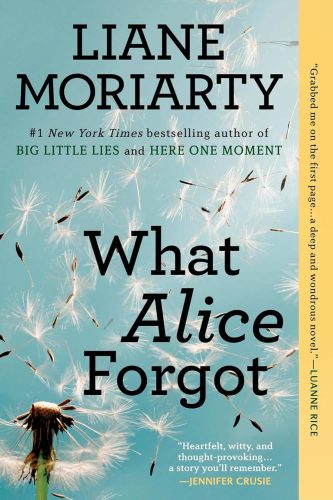
 “Maybe every life looked wonderful if all you saw was the photo albums.”
Author: Liane Moriarty
After a gym accident, Alice has forgotten ten years of her life. She entered the gym as a forty-year-old, soon-to-be divorced mom of three who was happily dating, career-oriented, and known for her overly organized take-charge attitude, fancy dresses and heels, and abrasive attitude. She exited having lost a decade, thinking that she was 29, newly married and pregnant, adoring sweatpants and chocolate, a little mousy, looking for the comfort of her husband and shocked to discover that everything has fallen apart – including her relationship with her family. What could have happened in those ten years to ruin her happily ever after?
As Alice waits to regain her memory, she is forced to go on with her daily life: raising three children she doesn’t remember, being beset by committees and people relying on her planning and organizing skills, and trying to navigate her now hostile relationship with Nick. Did he cheat? Did she? What happened to their love? Whatever it was, it clearly was a mistake, and she will do what she can to keep this divorce from going forward.
Meanwhile, Alice is also discovering that she has an antagonistic relationship with her sister, Elisabeth. Her once mousy mother is now addicted to salsa dance and married – to Nick’s father of all things! And her grandmotherly next-door neighbor, who did so much for her as a child, isn’t speaking to her. Who has Alice become and why? What about Nick? How could her gentle, soft Nick speak to her in this way? And their house – it looks like they made their dreams come true. Everything is fixed just the way they envisioned, a perfect dream home. Yet it appears that their dream turned into a nightmare, and no one will tell her why. Meanwhile, everyone is avoiding the mention of another person Alice doesn’t remember: Gina Boyle. Apparently, this Gina was the catalyst for everything, but all Alice can remember is a stormy day and wind in the trees.
What Alice Forgot is a powerful story about how people change and about how life shapes us. Now, that may ultimately sound like the typical chick-lit / contemporary fiction focus, but Moriarity crafts it so well that the meaning is still rife and sharp. It has the complications, the ups and downs, the subtilties and loves and hatreds of real life. The entire story is a gut punch, and we learn along with Alice, who is now a woman in her forties, facing the consequences, but with the personality of a woman in her 20s who still can’t see the forest for the trees or understand the ravages of time, family, exhaustion, and the complications of interactions and little mistakes that build into big arguments.

The story and the way it approaches Alice’s life has a fresh, unique feeling to it, even though the amnesia plot is a soap opera favorite. What can I say, Moriarty makes me believe. It’s organic, and we come to care for all the flawed characters, from the abrasive Nick to the childishly hopeful Alice, still caught in the glow of a love that faded a decade ago, to the grieving Elisabeth, who is struggling with a decade of infertility. We want everything to work out – Alice brings out our formerly hopeful, younger selves – but we also know what Alice is struggling to realize: life is complicated. People, events, situations, relationships, they get broken, and sometimes they cannot be fixed. If they are, they become something different. Things cannot remain the same, and time has a way of wearing the happy edges away and making us all more aggressive, more impatient, and more confident.
As the story unfolds, we get bits and pieces as Alice’s memory comes back and as we watch the dynamics around her. We also get more into the novel’s side story: Elisabeth’s feelings of jealousy and exclusion. To her, Alice’s life is still a happily ever after, despite the divorce. Alice has three wonderful children. She has a boyfriend. She has her beautiful dresses and her perfect life, and everyone looks up to her. Meanwhile, Elizabeth is slowly falling into a deep and beleaguered expression. Moriarty gently and expertly investigates the complexities of fertility issues, something that even now is rarely explored in novels. She is sensitive and frankly, accurate, capturing the wearing of endless rounds of medical experimentation, lost pregnancies, and shattered hopes.
As the novel comes to a conclusion, we are emotionally and intellectually invested, at times heart warmed and at other times heartbroken. The ending keeps to the cheerful nature of the genre – it’s still a semi-romance, contemporary chick-lit sort of thing – but you know what, that works. We needed that. And there is definite growth in all the characters, a complete and realistic and utterly absorbing arc. This is the stuff of real life, painted with compassion and the occasional flare of humor. There are lessons here, but we also step away having enjoyed the experience and feeling refreshed. Highly recommended.
– Frances Carden
Follow my reviews on Twitter at: https://twitter.com/xombie_mistress
Follow my reviews on Facebook at: https://www.facebook.com/FrancesReviews

- Book Vs Movie: The Shining - April 6, 2020
- Thankful For Great Cozy Mysteries - December 13, 2019
- Cozy Mysteries for a Perfect Fall - October 20, 2019