


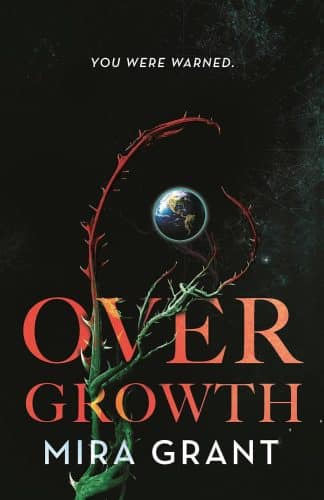
 “To Plant a Garden is to Believe in Tomorrow”
Author: Mira Grant
Anastasia Miller (Stasia) hasn’t been herself since she was three years old. That was because she was eaten by an alien plant and the original, human Stasia is dead. In her place is a plant person with an unrelenting desire to tell the world that she is the vanguard of an invading species. Let’s just say, this gives plant Stasia some unique social problems.
Now an adult, in her 20s, Stasia continues introducing herself as a space invader, explaining that eventually, the armada will come and the invasion will be on. Her few friends and her trans-boyfriend all say they believe her, of course, but they are really humoring what they see as a strange quirk of personality. But then, when a scientist leaks a message from space, it becomes clear that Stasia has been telling the truth all along.
Invasion of the Body Snatchers has long been one of my personal favorite stories, both in book form and the two movies (50s version and 80s version, respectively). When one of my horror book clubs chose Overgrowth for our traumatizing monthly read, I was desperately excited. I wasn’t even intimidated by the 460+ pages. If Body Snatchers suffered anything wrong, it was its shortness.
I soon came to regret both my enthusiasm and the extremely dense page count. While Overgrowth is touted as horror, it’s really more of a quirky, slow-paced, half-comedy sci-fi story with a relentless, preachy moral. It’s half irritating and half boring.
Why, you ask? Well, for starters, the actual invasion doesn’t start until about 60% into the book. That’s right, the plant on human carnage we came for is an aside. When the invasion does get started, our characters conveniently take a little trip to space, and we see none of it. NONE OF IT. Not good, Ms. Grant, not good. We came for the killing, but you gave us philosophy and endless internal monologues instead.
Likewise, all those abstracts with the words “body horror” need to be updated. If by body horror you mean plants that look just like people, but are green, then I guess you can keep the tagline. If that’s not what you mean, then this little metamorphosis hardly qualifies for either the label or any claim to imagination.
Since the aliens themselves aren’t the star of this supposed invasion-based story, what do we spend so much time on, you ask? Well, lots and lots of torpid, hyper-politicized, teenage conversation. Now, Stasia and co are supposed to be in their mid-to-late thirties. Yet, they all talk like teenagers, live like teenagers, and have teenage attachments. Any hint of realism is long gone, and this “we’re bffs, so I would totes surrender my entire species for you with zero worries” belongs in a YA book not an adult one. Thirty-five-year-old adults would have more complicated relationships and thought patterns.
Image by Nicky ❤️🌿🐞🌿❤️ from Pixabay
And then, we have the comparison of Stasia’s alienation – her “not belonging” trademark – to queerness (especially towards trans individuals) and towards immigrants. It is not the least bit subtle. Indeed, many times the characters make these observations out loud, with another character summing it up, just in case we didn’t get it. The poor horse here gets flogged, drowned, set on fire, sent to outer space, hit with a meteor, thrown into an underwater volcano, erupted brutally onto the land, eaten by a dinosaur . . . and yet the characters still aren’t done beating it. WE GET IT. Unfortunately, we got it so well, that we were jettisoned straight out of the story, and at some point started to wonder if we had actually turned on the dishwasher and taken out the trash. It doesn’t help when right in the middle of a fraught chase seen, Stasia turns to a giant alien winged dinosaur and interrupts the action to ask it its pronouns. I mean, really?
Also, the fact that each of these aliens begins their existence by murdering a child (literal child predators) and then they are used as the metaphor for trans people and immigrants – um, didn’t the author realize this might be problematic? Actually, yes, she did, because the narrative itself fights with this, and the justifications are weak. “We were seeds, we didn’t know what we were doing,” and “the humans were the initial aggressors” doesn’t cut it. No, y’all were the initial regressors, what with eating kids and all.
And don’t get me wrong, that beginning chapter with human Anastasia finding the beautiful plant and going to an utterly grisly death is well executed (and the only horror moment in the narrative). But from there, the rest of the story is totally different, and the points the author made about peace and war did not work with the plant species’ predatory nature. The story tries so hard to justify the initial act and tries to make the aliens the good guys turned rouge because damn it, they are tired of the abuse and more than ready to strike first. It could have worked with more finesse and the acknowledgement of grey areas, but the story just couldn’t make it happen.
The conclusion ramps up the action a bit, and it is neat to FINALLY be on the spaceship and talk to the other plant people aliens (thus earning these two stars instead of the zero it probably deserves). But, for nearly 500 pages, that’s just not enough to make the time or effort of reading worth it. Ultimately, Overgrowth is not the horror novel it promises. It had potential as a science fiction piece, but it tried too hard, was way too slow, and spent too much time on a soap box and too little time world building and character building. In the end, I was relieved to be done with it. This is my last Mira Grant. Her books just don’t sing to me. Not recommended.
– Frances Carden
Follow my reviews on Twitter at: https://twitter.com/xombie_mistress
Follow my reviews on Facebook at: https://www.facebook.com/FrancesReviews

- Book Vs Movie: The Shining - April 6, 2020
- Thankful For Great Cozy Mysteries - December 13, 2019
- Cozy Mysteries for a Perfect Fall - October 20, 2019