


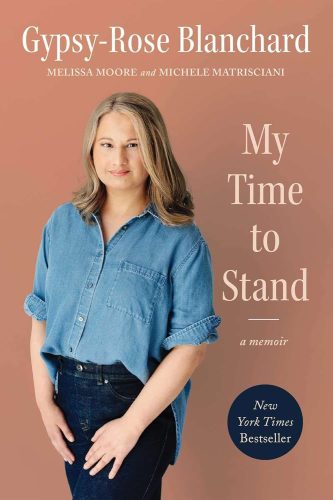
 Killer or Victim or Both?
Author: Gypsy-Rose Blanchard
The story of Gypsy-Rose Blanchard has created a cultural awareness (and many fictional accounts) of Munchausen by proxy: a syndrome where a caretaker fabricates an illness for the person under their care to get fame or attention. At the age of 23, Gypsy rebelled, conspiring with a secret boyfriend she made online to murder her mother and escape the cycle of abuse.
The case led to many allegations (and lots of spinoff media, from Gillian Flynn’s Sharp Objects to the Hulu series “The Act.”) Gypsy claimed that her mother abused her, that her multiple dire illnesses were never real, that she was forced to act as though she had the mental age of a seven-year-old, and that she was also told to pretend that she was unable to walk. She tried to escape. Eventually, her loneliness led her to make secret online profiles and fall into the clutches of a murderous sociopath who hatched the scheme of violence that led to him stabbing her mother to death while she hid in the bathroom.
After serving a short jail sentence, Gypsy is free again and has penned this memoir to tell her side of the story. I discovered it after listening to a Bailey Sarian’s podcast about the case. I’d heard of it before, as have a lot of people, and decided I wanted to learn a little bit more. A quick Amazon search turned up My Time to Stand, and I decided to start my reading there. Where better than to hear the story of what really happened than from Gypsy-Rose herself?
That being said, My Time to Stand is ultimately a letdown. Not to say that I could tear myself away, because the rubber-necking tourist in me was fully engaged, but I left having felt that I saw just another form of fiction – and not particularly detailed fiction at that. This story, as it is, remains largely untold, and it’s obvious that just as Dee Dee established her own reality, Gypsy has done the same. Perhaps it’s understandable, the natural result of an abused child driven to the limit, or perhaps it’s more self-serving and nefarious than that. Who can really say?
Gypsy doesn’t give us a lot of details about her early life and the abuse. They are cursory. She mostly just says: “Yeah, mom wanted to rip off the charities. So, she told me to pretend to be sick, and she made me have surgeries.” But that’s the level of details, a super quick, “you already know this, whatever” maneuver that didn’t help to draw me into the situation and understand Gypsy’s ultimate actions.
Image by Niek Verlaan from Pixabay
The narrative is also undisciplined. There is no chronology, and Gypsy often interrupts herself to go onto diatribes about how she is justified to hate her mom, but has learned better, has learned compassion and understanding from her classes while in jail. She sees that her mother was sick. Yet . . . the lady doth protest too much. We have a lot of these oscillating sentiments, these pages upon pages of: “I’m totally justified in what I did, you know, but, of course, I had this jail class about understanding the depths of what I did, and I do feel bad about it, although I am totes innocent and it wasn’t my fault, and I didn’t do it anyway, the evil boyfriend who manipulated my innocence and goodness did.” These, of course, are grand oversimplifications, but my point remains. Ultimately, we hear Gypsy telling us in the background: “I was right, you know. I wasn’t a killer. I was a victim. And I was justified.” Just say it then, instead of pretending that you have come to some transcendent, better understanding, realizing that murder is never justified, despite the provocation. Stand your ground and say what you mean, because the narrative and twisting back and forth is fooling no one. Own it.
And this issue, this pretense, continues throughout the entire narrative. While we get no real background of the medical issues and abuse, we get a lot about Gypsy’s first two online boyfriends, especially the second one, Nick, who was the murderer. As Gypsy tells it, she was so desperate for normalcy that she didn’t think his violent sexual fantasies, including raping her mother, were that weird. Here, Gypsy gives a lot of details about the developing relationship, stressing her ultimate lack of knowledge. She didn’t know better, couldn’t have known better, and although it wasn’t an excuse, her desperation drove her into the arms of these cunning sociopath types. It doesn’t ring true, and that self-justification gives everything a fictional tint.
As the short memoir continues, the questions mount. If, as Gypsy said, Dee Dee never allowed her to walk, even at home, then honestly, she wouldn’t have been able to walk at all. Her muscles would have atrophied, as happens to people who are bed-bound. Likewise, it makes sense that a child, innocent, trusting, naïve, would go with such a con. But a twenty-year-old woman? Why was she still staying, still playing into it, when she even admits telling the neighbor secrets? Why didn’t she go to social services herself? She was an adult at the time of the crime – a crime planned for over a year. A crime for which she bought and hid the knife.
Things don’t add up, and while it is clear that Gypsy was abused and used, it’s equally clear that the full story still hasn’t been told. Gypsy races through the end of the memoir. She is married, divorced, pregnant, and in a new relationship again within a few sentences. We’re left with the sense of a poorly curated narrative, and because of who she is and what it is, we still read, eyes glued to the page, but as far as the whole truth – it’s not here. We’ll probably never have it.
– Frances Carden
Follow my reviews on Twitter at: https://twitter.com/xombie_mistress
Follow my reviews on Facebook at: https://www.facebook.com/FrancesReviews

- Book Vs Movie: The Shining - April 6, 2020
- Thankful For Great Cozy Mysteries - December 13, 2019
- Cozy Mysteries for a Perfect Fall - October 20, 2019