


 Fight Like Charlie
Author: Lawrence Ingrassia
It’s standard now when you go to the doctor – that long litany of relatives, close and far, and every disease they’ve ever had, at what age, to what extent, and success (or failure) of treatment. Cancer, of course, is the one we all fear the most, and from young ages we start to memorize the people in our line, many of whom are only a bare flicker of memory, and how cancer morphed their future. But it wasn’t always like this.
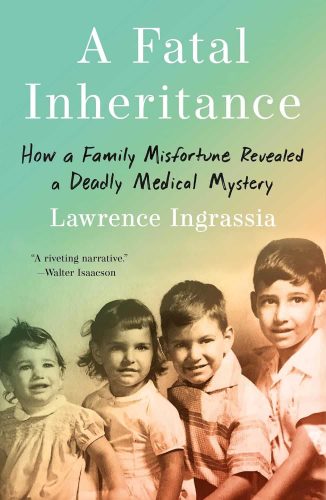
Enter A Fatal Inheritance where journalist Lawrence Ingrassia examines both his wrought family history and the history of the Kilius family, both of whom suffered a seemingly abnormal rate of rare cancers. Doctors Frederick Pei Li and Joseph Fraumeni Jr. would eventually become intimately involved with these families, running decades long studies that revealed what few suspected before: cancer can be inherited. Now, it’s a given, but then, as research started in the 70s and launched new meanings and interpretations in the 90s, it was a groundbreaking revelation that led to some hope and much fear. Would you want to know if cancer was woven into your genome if your chances were high and treatments and preventions low?
It turns out that Li and Fraumeni discovered a faulty gene TP53 (called p53), which instead of causing cancer failed to enable the body to perform its usual preventative tasks. Eventually, this led to discoveries of other genes (including the one for breast cancer) and the naming of P53 deficiency as Li-Fraumeni syndrome. Along the way scientists battled other researchers to release the vital news and fought against skeptics in their community.
It’s all astoundingly important and amazingly untold. I grew up knowing that cancer has a heavily genetic component – after all, most of my family on my mother’s side passed early from cancer. It’s a bugbear that haunts my family, and a litany I myself have to divulge at every doctor’s visit. But only a few decades earlier this vital information was unknown. Li and Fraumeni have done so much for the scientific community and for people who previously had no hope – yet the story is buried. And partially, it’s buried because it’s dry.
Despite endless personal accounts from both the Killius and Ingrassia family, all of which are heartrending and tragic, the story is mostly one of science, and science, to be any good, is endless lab time, experiments, hypothesis, papers, speeches, more experiments, more doubts, and so forth. It doesn’t make for thriller type reading, despite its evident importance.
How then can you make something so fundamental also fascinating? It’s difficult, and although Ingrassia did a fantastic job breaking the science into understandable component parts and bringing the very real story of these families to life, I still found my attention wondering, my heart knowledge fading into head knowledge, and my focus shifting. Could it have been written differently to bring everything alive, to make the scientists less static and more dynamic in their quests? Maybe. But that’s a tall order, and not one I could fulfill.
And so, I leave this story a tepid reader, but an incredibly grateful and impressed learner. This is a story we should know and a team of intrepid researchers, and the families who shared with them, who deserve our gratitude.
– Frances Carden
Follow my reviews on Twitter at: https://twitter.com/xombie_mistress
Follow my reviews on Facebook at: https://www.facebook.com/FrancesReviews

- Book Vs Movie: The Shining - April 6, 2020
- Thankful For Great Cozy Mysteries - December 13, 2019
- Cozy Mysteries for a Perfect Fall - October 20, 2019