


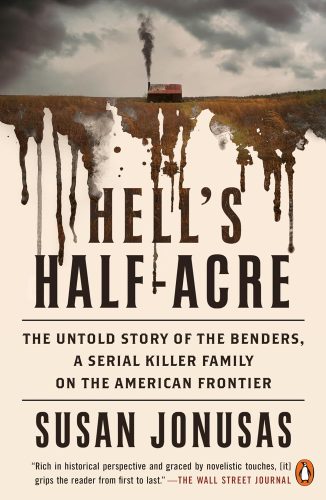
The Benders: Fact or Fiction?
Author: Susan Jonusas
It’s 1873, Labette County, Kansas and the West is still very much wild. It’s no surprise then that a family of serial killers could remain, preying off lonely travelers, for years. It’s also no surprise that this family, knowing that they were finally discovered, were able to easily disappear, leaving police, investigators, and heartbroken relatives of the murdered to chase answers and justice for two decades with few results and no real answers. Even still, the story of the infamous Benders is more legend than fact, speculation piled on top of a gory historical moment that leaves us wondering – what else happened out on that lone prairie, far from prying eyes? Perhaps the Wild West was far more brutal than we ever realized.
Hell’s Half Acre is different from most of the other true crime books that I’ve read in that most of it is supposition or legend. We know for a fact that the crimes took place, and we know who the dead were. Author Susan Jonusas gives us plenty of facts alongside vivid descriptions of the exhumation, which became a community affair and is immortalized in haunting, grainy photos. What we don’t know is the why, the who, the when, and the final fate of the Benders.
From this perspective, Hell’s Half Acre has a very fictional quality to it, especially the second half of the book, when the trail goes cold and supposition and an alleged confession from an untrustworthy and violent individual is said to shed light on the mystery. It really doesn’t. All the Benders must have known what was happening – but to what degree were they all involved? Was there a killer and a family of accomplices, or was this some sort of Texas Chainsaw type family? No one can say, nor can the motive truly be unearthed. Robbery is suspected, but there is something more here, something sadder and far more base.
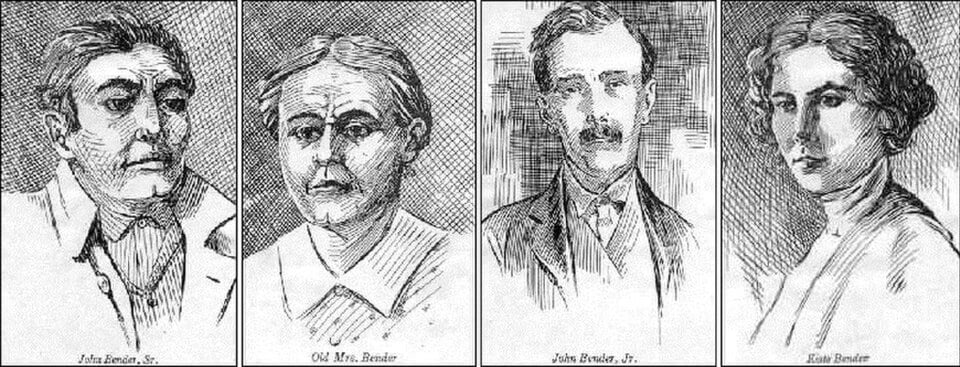
The Benders in Kansas
John Towner James (author), Kan-Okla Publishing Company (Wichita, KS), publisher.
Once the Benders disappear, it all becomes murky, and we’re left to wonder just how the author is creating these long, quoted conversations. The sources aren’t obvious, and when they are mentioned, they feel more like the stuff of urban legend, like gossip and hearsay, than facts. And, of course, this is one mystery that science and witnesses can’t solve. It’s too old. We’ll never know, but for all that, the book is ultimately uncomfortable with its own ambiguity and seeks to paint in spaces it couldn’t possibly know. This is where we transition from lurid fascination to distrust. Is this fiction or fact? Where does the known end and the speculation begin?
After the exhumation, there is little more to say, and so the second half of the book is desperate filler. The Benders are long gone, with sparse sightings. There’s not much you can do here, and so we learn about the town, the people, the victims, the suppositions, the attempts at solving. It stretches on too long. It extrapolates and tries to fill space that is forever blank. It’s well written, dynamic and personable and lively even, but it can’t make up for the fact that the mystery it has chosen is unsolved. Once the grisly discovery is unveiled, there really isn’t much left to say.
I enjoyed Hell’s Half Acre – it raises interesting questions and gives a scary new angle to life on the prairie that Laura Ingalls certainly never captured, but it has the ring of fiction to it, and we’re ultimately left doubting if any of what we read was true, or if this is an incident that turned into a legend that turned into a novel that lost itself because there is no real conclusion. Recommended, but don’t come expecting too much from this book and double check everything that is claimed as true.
– Frances Carden
Follow my reviews on Twitter at: https://twitter.com/xombie_mistress
Follow my reviews on Facebook at: https://www.facebook.com/FrancesReviews

- Book Vs Movie: The Shining - April 6, 2020
- Thankful For Great Cozy Mysteries - December 13, 2019
- Cozy Mysteries for a Perfect Fall - October 20, 2019