


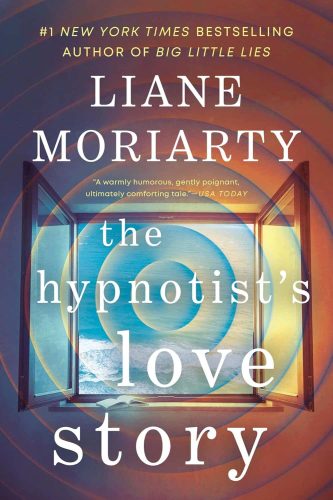
“You weren’t meant to admit, even to yourself, how badly you wanted love.”
Author: Liane Moriarty
Ellen O’Farrell lives in the beautiful, glass-lined sea house she inherited from her grandparents. As a practicing hypnotherapist, she understands that location is everything. She has seen how the light playing across the wall, how the gentle sight and sound of the ocean helps her clients open to their own inner knowledge.
There’s just one thing missing from this idyllic life: another person to share it with. She thinks she may have found that in Patrick. It’s early days yet, but something about their dates elicits so much comfort. They just feel right together. She knows he is a widower with a young son, and she’s a bit intimidated by the perfection of his dead wife. Yet . . . still . . . something tells her this is it. This is the one for her.
Of course, all relationships have problems. With Patrick, there is the haunting ghost of Colleen, his dead wife, but there is also another woman with a hold over Patrick: Saskia, his stalker. Saskia follows him and his young son, Jack, everywhere. She breaks into his house, goes to his son’s games, leaves him letters and long texts. She has even shown up during his dates. It’s a big red flag, to be sure, but Ellen is more intrigued than appalled. What could this woman be feeling, to do such a thing? Surely, there is no real harm in her . . . Perhaps there is even a strange kindred nature.
The Hypnotist’s Love Story is one of Liane Moriarty’s stranger offerings, as the title no doubt suggests. The entire hypnotherapy angle is a bit out-there, and Ellen often finds herself miffed that no one – family or friends – takes her field seriously. Yet . . . it’s a stretch, even for her empathetic readers, especially when she goes beyond pure professionalism to use her “powers” to plant suggestions in Patrick’s mind and get him to answer questions about his dearly departed. This is presented more as a professional quandary, a moral question, than a practical “is this really possible” question, and that does hurt the narrative. We don’t believe it, we can’t, despite the very well-done groundwork Moriarty has laid to explain what the field can and cannot do (i.e. it’s more suggestion than mind control, etc.)
What the narrative has to say about stalking, and how men treat women, is more complicated and nuanced, and, let’s be honest, kind of problematic. Alongside Ellen, we are set to empathize with Saskia, who was essentially Patrick’s rebound/grieving relationship. She accepted that, and along with her three-year relationship with Patrick, where she gave all and he gave nothing, she also raised his son and became the boy’s mother. The breakup came after her own mother’s tragic death, when she needed some empathy. Patrick, clearly, is a bastard for how he treats her, but does that truly justify the endless stalking? I’d argue no, and that the unabashed sympathy here might be doing more harm than good. If it were reversed, and this was the story of a man stalking a woman and her child, whom he felt he had raised, it would certainly have a higher creepy factor.

Image by kp yamu Jayanath from Pixabay
The author does touch on that some, even having Ellen admit towards the end how the stalking impacted Patrick and how, had the situations been reversed, she would have felt empathy for a woman with a male stalker. Still, the moral is muddied here, and while Saskia is a good character, a person who brings us into her sphere of alternating longing and grief and the heartbreak of a lonely life, I wonder at the expediency of giving a stalker so much page space, so much forgiveness and kindness.
The other main portion of the narrative is focused on Ellen and Patrick’s relationship and the idea of being a “second” love. This is handled quite well, and we do feel for Ellen as she grapples with jealousy. Colleen is forever perfect. After all, she was the first love. The first wife. The mother. Patrick still clearly grieves her and mentions her continuously. Yet, the narrative does successfully explore the different kinds of love we can hold for one another and navigates the complexities of such a relationship with realism and compassion.
In the end, we get the traditional Moriarty happily-ever after. Her endings are always soft, always a little anticlimactic, and The Hypnotist’s Love Story is no exception. The thing is, it kind of works well here, since the narrative itself was gentler, less drama and more slice of life, internally focused.
This wasn’t my favorite Moriarty story, but it is still good quality. If it had been the first book of hers I’d read, I’m sure I would have loved it even more, but compared with classics such as What Alice Forgot, this one doesn’t quite make it to the top of the Morarity list. It’s still high up there, though. A pleasure to read. An insightful, complex, character and relationship driven book with a soul. Recommended.
– Frances Carden
Follow my reviews on Twitter at: https://twitter.com/xombie_mistress
Follow my reviews on Facebook at: https://www.facebook.com/FrancesReviews

- Book Vs Movie: The Shining - April 6, 2020
- Thankful For Great Cozy Mysteries - December 13, 2019
- Cozy Mysteries for a Perfect Fall - October 20, 2019